🔎 This article is part of our complete dossier: Essential oil and colds – the complete guide.
Did you know that a single drop ofniaouli essential oil can help relieve a blocked nose, calm a respiratory infection or even soothe a fever blister? Behind this discreet plant lies a treasure trove of aromatherapy: niaouli(Melaleuca quinquenervia or Melaleuca viridiflora), a tree native to New Caledonia and Madagascar, whose essence abounds in antiviral, antibacterial and healing properties.
Less well-known than ravintsara or eucalyptus radiata, chis pure organic oil nevertheless proves effective against many ailments from winter colds skin infections such as eczema or herpes, as well as irritations and minor burns. Inhaled, diffused into the air or applied to the skin in well-diluted form, it can be easily integrated into the family’s natural skin care routine.
Still little-knownniaouli essential oil deserves a real guide to its benefits, uses and precautions. Let’s discover why this discreet bottle could become a must-have in your natural remedy kit.
A tree between tradition and modernity
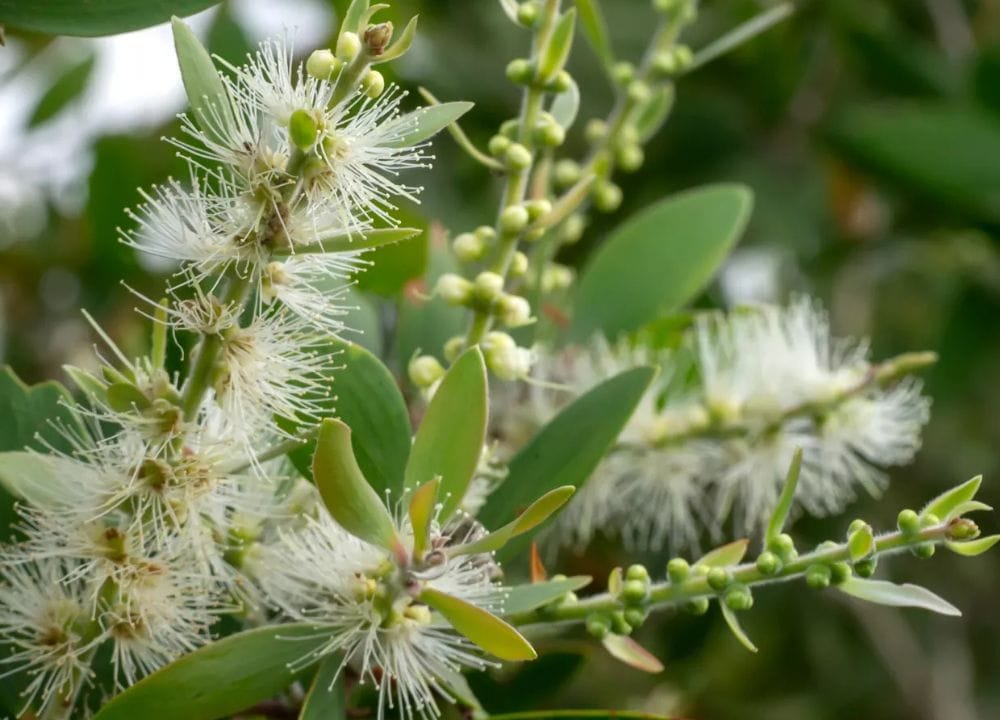
Niaouli(Melaleuca quinquenervia) belongs to the large Myrtaceae family, and to the same Melaleuca genus as tea tree ( Melaleuca alternifolia) and eucalyptus. Native to New Caledonia, it also grows in Madagascar, where it is widely cultivated and distilled. Its long, leathery leaves concentrate an essence rich in 1,8-cineole (also known as eucalyptol), alpha-pinene and viridiflorol: molecules that largely explain its therapeutic effects.
In its native region, niaouli is more than just a medicinal resource. Kanak populations have long used it in the form of decoctions or poultices to treat infections or accelerate healing. Sailors plying the Pacific Ocean used it to disinfect their wounds. Introduced to Europe in the 19th century, the tree gradually established itself as a valuable source of essential oil. Even today, it retains this dual identity: traditional local plant and modern ingredient of scientific aromatherapy.
Do you remember Gomenol, a product that was a staple in family pharmacies for a long time? Behind this name was hidden theessential oil of niaouli. Used since the early 20th century, gomenol was prescribed for respiratory ailments. Although it has gradually disappeared from the shelves, this memory illustrates the extent to which niaouli is part of the history of medical aromatherapy. Today, although the name gomenol has been forgotten, the essence obtained by steam distillation of its leaves continues to be used for its antiviral, antibacterial and healing properties, but in a more modern and regulated context.
The many benefits of niaouli essential oil
Powerful action on the respiratory system
This is undoubtedly the best-known and most studied indication. Thanks to its high eucalyptol content,niaouli essential oil is anti-infectious (antiviral and antibacterial), expectorant, mucolytic and anticatarrhal. In other words, it helps to thin secretions, clear the nose and free the bronchi. It is therefore particularly useful during episodes of coldssinusitis sinusitis, bronchitis or winter coughs.. Some practitioners consider it an alternative to ravintsara, especially when you’re looking for an effective oil that’s a little gentler on the mucous membranes.
Moist inhalation (two drops in a bowl of hot water, followed by ten minutes of steam) is often enough to bring rapid relief. is often enough to bring rapid relief. Atmospheric diffusion purifies the air, creating a more breathable atmosphere during winter epidemics.
An antiseptic and healing skin care product
L’niaouli essential oil is not limited to ENT. On the skin, its antimicrobial and healing properties make it useful in many contexts. Dermatologists are particularly interested in niaouli for its effectiveness against cold sores (anti-viral): applied very locally, always diluted in a vegetable oil, it helps to limit the evolution of the pimple and reduce discomfort. It can also be used to soothe mild acne, purify oily skin or help repair superficial burns.
In some oncology departments, it is even incorporated into protocols designed to soothe patients’ skin after radiotherapy, in order to limit the onset of radiodermatitis. This type of clinical use clearly illustrates the versatility of this essential oil, which is capable of moving from the family bathroom to the hospital.
Immune and energy support
Beyond its direct effects on microbes (infection) or skin irritations, niaouli also acts to stimulate the body’s natural defenses. Its fresh, penetrating fragrance, rich in eucalyptol, is a tonic for the mind. Diffused in the office, it helps maintain concentration and counteract intellectual fatigue. In winter, it can be used preventively, in synergy with other essential oils, to support the body against circulating infections.
How do I use niaouli essential oil?
The cutaneous route: the most common
This is the safest and most widespread method. But like all eucalyptol-rich essential oils, niaouli must be diluted. Two to three drops in a teaspoon ofvegetable oil (sweet almond, sesameor argan), applied locally once or twice a day. For a fever blister, you can target the area for a few days. For a small burn or superficial scar, a gentle massage helps repair the damage.
Inhalation and diffusion
For colds, sinusitis and blocked noses, steam inhalation is still very effective. Two drops in a bowl of hot water are all you need. Then calmly breathe in the steam for two to three minutes, closing your eyes to avoid irritation. Diffusion is useful for purifying the air in a room: about ten minutes is enough. On the other hand, it is not recommended to diffuse while sleeping.
Niaouli blends well with fine lavender (soothing and healing) or lemon (purifying and toning).
Oral route: only under medical supervision
Some practitioners prescribe niaouli orally on a neutral carrier for respiratory or urinary tract infections, but this use should be reserved for a doctor or doctor of pharmacy. Self-medication by mouth is not recommended: dosage must be strict, and possible interactions must be taken into account.
Useful synergies
L’niaouli essential oil combines particularly well with peppermint to clear the respiratory tract. Applied to the skin, it forms an effective duo with fine lavenderwhich completes its healing action. Withtea treeoilit forms a useful antiseptic synergy against mycosis and acne.
Practical information: simple recipes with organic niaouli essential oil
- Persistent cold or sinusitis Pour 1 drop oforganic niaouli essential oil and 1 drop of lemon into a bowl of hot water and breathe in the steam for 2 to 3 minutes. This simple gesture helps open up the respiratory tract thanks to cineole, a key compound in this essential oil.
- Fever blister or localized shingles: dilute 3 drops of niaouli in 1 teaspoon of neutral vegetable oil, then apply gently to the area morning and evening. Niaouli is used here for its antiviral properties and for weakened skin.
- Dull or irritated skin: prepare a simple recipe: 1 drop of niaouli + 1 drop of lavender in 1 tablespoon of aloe vera gel, massaging gently into the face. This synergy promotes mild eczema.
- Heavy legs: mix 3 drops of niaouli with 1 spoonful of sesame oil, then massage in. We sometimes read thatniaouli essential oil can be used to relieve the sensation of heavy legs, varicose veins or muscular fatigue after a day on your feet. In reality, it is not the most suitableessential oil for this purpose. Although it has antibacterial and
anti-inflammatory virtues, and promotes the repair of certain skin areas, its action is not sufficiently targeted on the venous system to offer a powerful or lasting effect. Cypress essential oil is a natural remedy that can help reduce the sensation of varicose veins or muscular fatigue after a day on your feet.
- Bacterial infections: with medical advice and prescription.
Remember: always dilute and use a bottle of pure, organicniaouli essential oil, a guarantee of quality and safety.
What do users and professionals have to say?
Reviews and testimonials onniaouli essential oil are generally positive. Users report notable effectiveness on mild ENT infections, especially when inhaled. Many describe it as an invaluable aid for relieving a blocked nose or calming a persistent cough. On the skin, feedback from users underlines its value in treating herpes labialis and supporting wound healing.
Among health professionals, pharmacists stress the importance of dilution and short duration of use. Aromatherapists point out that this oil is not a substitute for antibiotic or antiviral treatment when this is necessary, but that it is an interesting natural support. Finally, some hospital departments are exploring its supervised use, proof of a growing interest in integrative medicine.
Advice and precautions for use
Like all essential oils, niaouli should be used with caution. It is not recommended for children under six, for pregnant or breast-feeding women without medical advice, or for people with asthma or a history of seizures. In the event of an allergic reaction, it should not be used again.
Niaouli essential oil, like all cineole-rich oils, must be used with caution. It is not suitable for children under the age of six, nor for pregnant or breast-feeding women, except on medical advice. It should not be applied pure to the skin: always dilute it in a vegetable oil before use.
More specifically, it has its own contraindications, due to the presence of compounds with potential hormonal activity. It is not recommended for anyone with a personal or family history of hormone-dependent cancer or hormonal disorders.
It’s best to limit cures to a few days, just long enough to relieve an infectious or cutaneous episode. In the event of high fever, persistent pain or worsening or recurring symptoms, consult a doctor. Niaouli is an ally, not a miracle solution.
Ecological and ethical impact
Melaleuca quinquenervia is an essential tree for New Caledonia‘s wetland ecosystems, and its over-exploitation could permanently weaken these environments. The essential oil obtained by steam extraction of its leaves should not be considered a trivial resource. Choosing a bottle of essential oil is not something to be taken lightly: organic production, artisanal distillation and hand-harvesting guarantee both product quality and the preservation of natural resources.
Traceability also plays a part in this requirement: clear labelling indicating the Latin name, origin, batch number and distillation method is a sign of seriousness. Behind every little bottle lies a significant quantity of plant material, harvested and processed with care. Using it in moderation means respecting the plant, the people and the land that produced it.
Conclusion: an essential oil to rediscover
Discreet yet effective,niaouli essential oil is a little-known treasure of aromatherapy. Its respiratory, antiseptic and healing properties make it a precious ally against winter infections and certain skin problems. Easy to use by inhalation, diffusion or diluted skin application, it offers a natural alternative, provided safety rules are observed.
An ally of immunity and skin support, niaouli perfectly illustrates the balance between traditional knowledge and modern approaches. Far from being a secondary oil, it could well become an essential winter companion, provided we learn to give it the place it deserves.

Editor: Camille Comet
Doctor of Pharmacy University Diploma (DU) in Aromatherapy
Fascinated by the power of plants since childhood, my expertise and passion focus on aromatherapy and the production of essential oils, with an ethical and ecological vision.