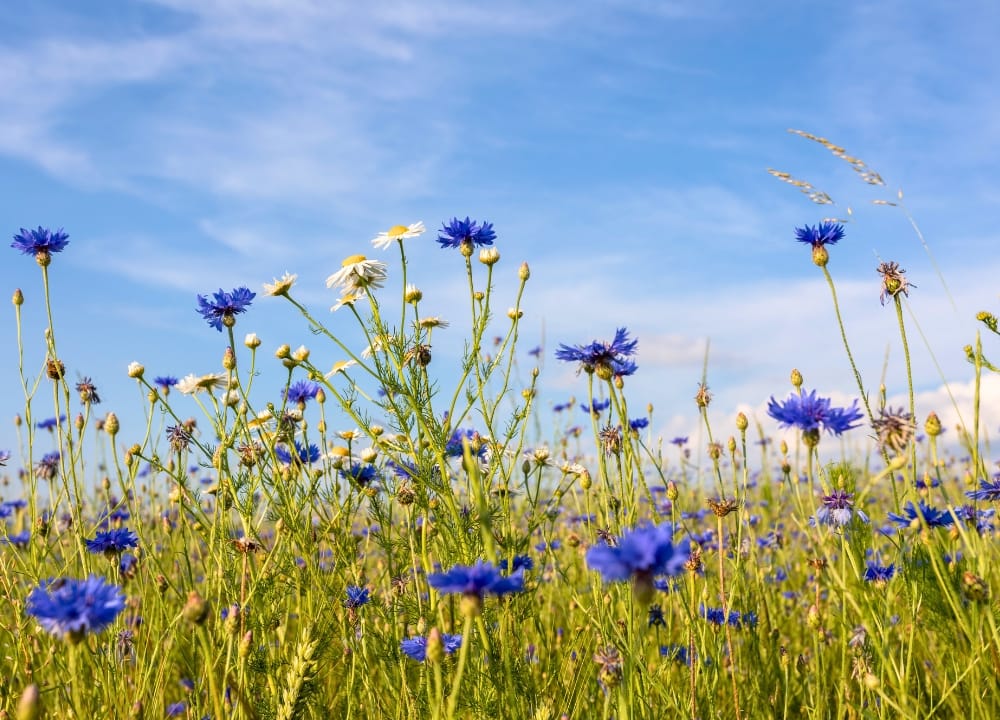
Eau florale or hydrolat: you’ve seen both on labels… but are they the same product? Lavender, Damask rose, witch hazel, cornflower, helichrysum… All these aromatic plants give birth to a precious, gentle and surprisingly versatile floral water.
Obtained by steam distillation, this aromatic water contains a low concentration of water-solubleessential oil molecules. It is neither a perfume nor a residue: it is a natural active ingredient in its own right, used in aromatherapy, cosmetics and even cooking.
But beware: not all hydrolats arecreatedequal. There’s a world of difference between anorganic bottle stored in the fridge without preservatives, and a generic floral water with a tampered perfume. And the consequences for skin, eyes and health.
This article will help you to tell the difference, to understand how these distilled liquids are obtained, why they are so precious, and how to use them on a daily basis, for natural, sensorial care that’s truly tailored to your needs.
The difference between floral waters and hydrosols: one product, two names
Hydrolat and floral water refer to the same aromatic liquid, obtained by steam distillation of a plant. The term “hydrolat” is the most scientifically accurate: it designates the recondenseddistillation water, which contains a small proportion of water-solubleessential oil molecules. The more poetic and popular term “floral water” is often used when the distilled plant is a flower: rose floral water, orange blossom floral water, chamomile floral water…
In reality, all hydrolats made from flowers are floral waters, but not all hydrolats are floral waters. If you distill rosemary twigs or peppermint leaves, you‘re talking about a hydrolat, not a floral water.
✨ Remember: hydrolat is a generic term, floral water a special case.
How do you obtain a hydrosol?
Hydrolat or floral water is obtained by steam distillation. In a still, the fresh plant is placed on a grate. Steam passes through the plant,drawing outits aromatic compounds, which then condense in a cooled coil.
This gives us two distinct products:
Theessential oil is lipophilic (does not mix with water) and floats on the surface,
Hydrolat, the aqueous phase containing water-soluble molecules.
This distillation process naturally produces these two substances. Hydrolat is therefore not a residual, but an “active water” containing between 0.03% and 0.2% aromatic molecules: an ideal concentration for safe, everyday use.
What defines a quality hydrosol?
Plant first
A good hydrolat always starts with a quality plant. At Boèmia, all our plants are organically grown or harvested from untreated areas. The plant is distilled fresh, after harvesting at the best time of day for its aromatic ripeness, if possible taking into account the lunar calendar.
🌿 Chamomile picked too late, or mint stored too long, is a hydrosol that loses effectiveness and fragrance.
Distillation know-how
At Boèmia, we distill slowly by steam distillation, in copper stills, with real respect for the plant and traditional know-how. traditional know-how. Copper enables a slight ionic exchange with the aromatic compounds, giving the hydrosol greater depth, stability and a unique vibratory energy.
We use a high distillation ratio, from 1 to 3 kg of plants for 1 liter of hydrosol. Below 1 kg/L, we shouldn’t even call it a hydrolat.
Gentle filtration, a guarantee of efficiency
here’s no need for over-filtration at Boèmia: simple filtration is all that’s needed, while retaining the active molecules. An over-filtered hydrolat loses its substance, its fragrance, its effect.
🌧️ A “flat” hydrosol is often a surfiltrated hydrosol.
Maturation
The hydrosol then rests for at least 4 weeks, protected from air, light and temperature variations. This resting time is essential for the water-soluble molecules to stabilize and the fragrance to become rounder.
How to recognize a good hydrosol?
It smells of fresh aromatic herbs, never of muddy water, alcohol or acid.
It contains no preservatives, alcohol or added flavoring.
It is packaged in a tinted bottle (blue or amber).
It always specifies:
The botanical name of the plant being distilled (Latin and French),
The distilled organ or part of theplant(flower, leaf, branch),
The origin,
Growing methods,
The date of distillation or bottling,
The 100% pure and natural label.
At Boèmia, we also add storage advice (DDM = date of minimum durability) and the possibility of contacting us directly if the consumer has a doubt or needs advice.
Storage and stability of hydrolats
Hydrolat is a living product, fragile but stable if we respect it. The enemy: heat, air and light. The key is to keep it in a well-closed bottle, in the shade and, if possible, in the refrigerator.
What to do if a deposit forms?
A light deposit is natural and of no consequence. What is abnormal :
A sour or musty smell,
The presence of filaments or glomerules.
What hydrolat has more than water
Hydrolat is more than just an aqueous phase. It is an emanation of the living plant, a medium of olfactory memory and subtle communication. When used on the skin, it has purifying, soothing, moisturizing and balancing properties. When used internally (food or hydrolatherapy), it has a gentle effect on the body.
They can even be used in synergy: in a cosmetic treatment, a recipe, or to accompany olfactory or emotional work.
Hydrolat and floral water practical use
Hydrosols and floral waters in cosmetics
Hydrolats are ideal for sensitive skin. Their mildness and low concentration of aromatic molecules make them ideal for daily skin care. Hydrolats and sensitive skin go hand in hand, justlike floral waters and fragile skin. Whether you opt for a hydrolat for sensitive skin or a floral water in cosmetics, you’ll benefit from a care product that’s both active and well-tolerated. In the world of cosmetic hydrolat or floral water, the difference between the two terms is minimal: both are derived from the distillation of plants and can be easily integrated into a natural beauty routine. Using a hydrolat in cosmetics means choosing a respectful approach, ideal for any woman with delicate or reactive skin.
Benefits hydrolat
The benefits of hydrolats are manifold and suitable for all skin types. A quality hydrolat provides gentle yet targeted effects: it can be purifying, soothing, toning or regenerating, depending on the plant distilled. Hydrosols are often used to calm redness, balance sebum or refresh the complexion. Unlike essential oilsessential oils hydrolats and floral waters are used undiluted, directly on the skin or even internally, depending on the indications. Each hydrolat’s effect depends on its plant of origin and its distillation method.
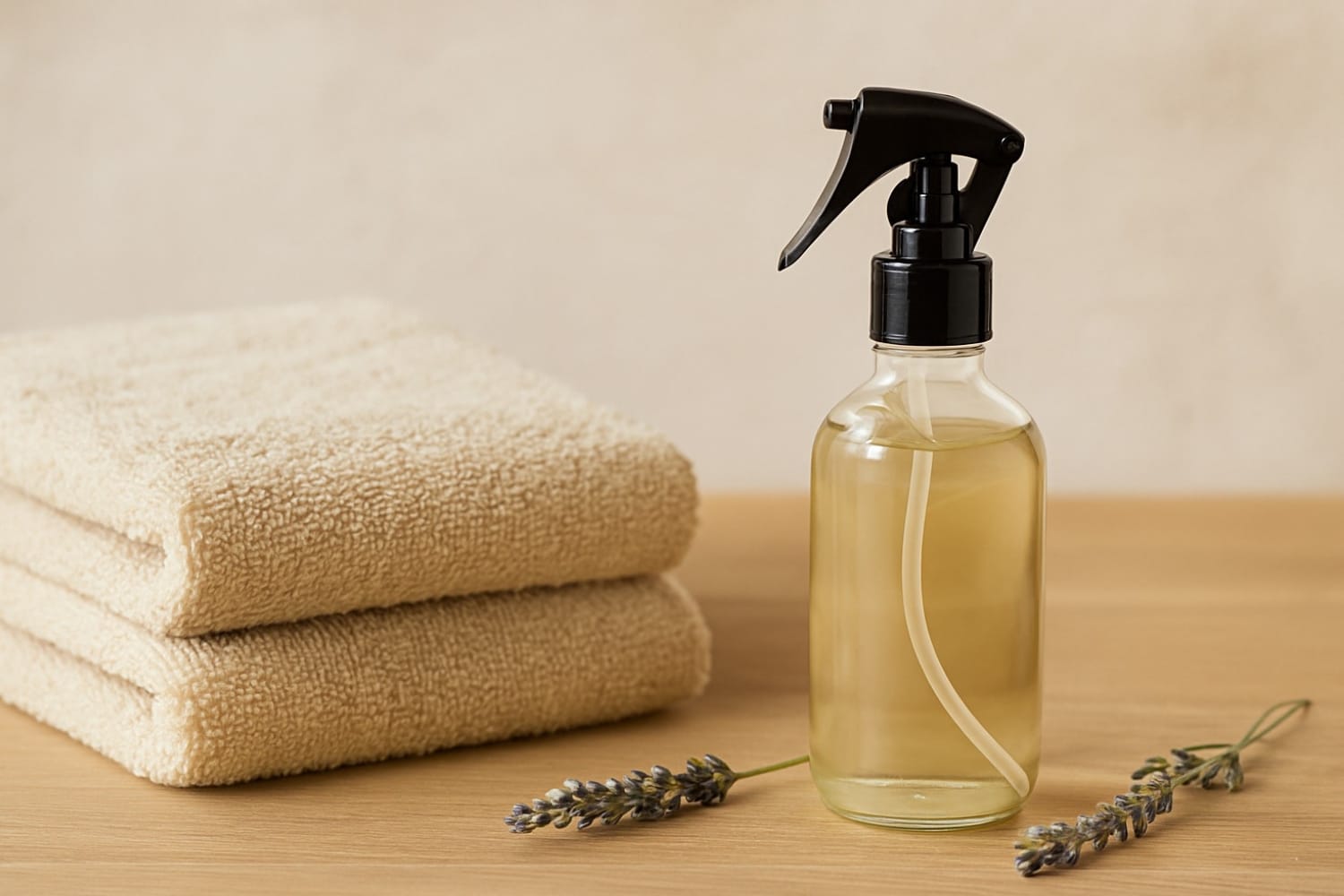
Using floral waters is easy. As part of a beauty routine,floral water is applied morning and night to a clean face, either with a cotton pad or as a mist. This application of floral water prepares the skin for skincare or refreshes it at any time of the day. Floral water can also be used as an eye compress, in a mist with our hair hydrosols, or to soothe the skin after sun exposure.
How to use floral waters as part of a complete beauty routine?
Combining hydrolats and floral waters for external and internal use allows you to take advantage of their multiple properties in a gentle and effective way. Here’s a beauty routine simple to incorporate into your daily routine.
Morning: toning lotion to wake up the skin
Apply floral water to clean skin with a cotton pad or as a mist.
Ideal for toning, refreshing and balancing skin pH.
Examples of care floral waters:
Rose floral water Radiance and softness for sensitive skin.
Thyme linalool hydrolate Toning and purifying effect for oily skin.
👉 This use of floral water prepares the skin to receive a skincare product or vegetable oil. plant oil.
🥄 Oral hydrolat
High-quality hydrolatpure, preservative-free artisanal distillation.
Dilute 1 tablespoonina glass of water, and drink in the morning.
Depending on the plant :
Rosemary verbenone hydrolate digestion, drainage, vitality.
Lemon balm hydrolate soothes the nervous system, relaxing hydrolate effect.
This complementary use supports the skin from within while rebalancing the body.
Evening – gentle cleansing and soothing
Reapply floral water after cleansing.
Provides a final gesture of freshness and soothing before the night.
Examples:
Orange blossom floral water Comfort and relaxation.
True lavender hydrolate Purification and healing action.
Why choose Boèmia hydrolats?
voiNos hydrolats are designed, grown, distilled and packaged with the utmost care, sincerity and know-how. We have chosen never to consider them as by-products. They are at the heart of our work.
Hand-picked organic or wild plants,
Plant/water ratio met or exceeded,
No additions, no cheating, no compromises,
A fragrance that speaks of plants, seasons and life.
Want to feel the difference?
📍 Discover our range of organic hydrolats on our online store
And if you’d like to go further, we’ve put together a guide to using hydrosols for skincare, cooking and well-being: download our hydrosol guides.