Distillation, transforming matter. Art-chemistry, separating and assembling.
The distillation of aromatic and medicinal plants is nothing new
The first traces of distillation date back to 6500 BC. India and China were equipped with primitive terracotta alembics to make extractions. A few centuries later, the Egyptians used oils to embalm their dead. Their technique, however, was not very elaborate… We’ll come back to this in an article on the history of distillation in our blog.
Mechanical extraction for citrus fruit
There’s a difference between essences and essential oils. For citrus fruits, we speak of lemon, orange, mandarin and other essences. They are obtained by cold-pressing the zest or pericarp, not by distillation or steam extraction. When you peel an orange, the liquid that sometimes escapes and stings your eyes is orange essence, commonly known as essential oil.
The principle of traditional essential oil distillation.
Aromatic plants, for their part, produce their essential oils by steam distillation, according to their essential oil-secreting organs: leaves, flowers, wood, roots…. Steam distillation is a simple process on paper, but more complex depending on the plant to be distilled and the quality of the essential oil to be obtained.
The principle of distillation is to pass a stream of steam (100°C) through the plants. On contact with this steam, the microscopic pockets of essential oil in the plants break open, releasing the aromatic molecules and their active ingredients into the steam stream.
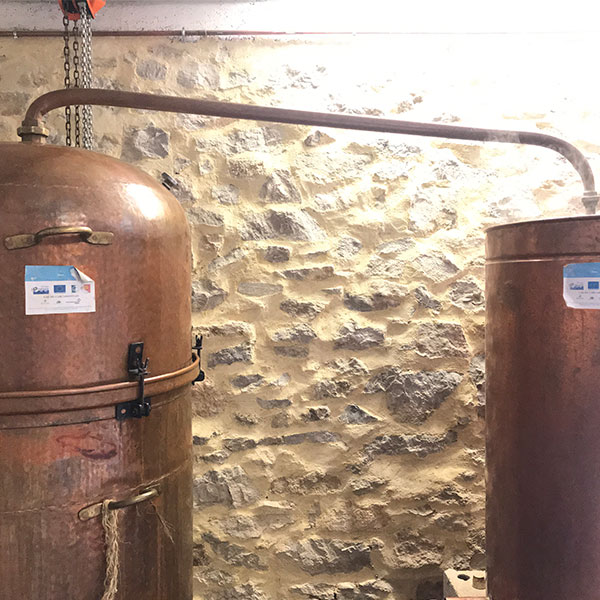
This steam, once loaded with aromatic molecules, continues its upward trajectory, passing through a horizontal tube and then back down again, guided inside a coiling coil immersed in cold water. Contact between this hot steam and the cold coil creates condensation of the steam-molecule mixture.
The result of this condensation is a solution that has returned to a liquid state, often milky or cloudy. This is the distillate: a mixture of hydrosol and essential oil. After a few seconds’ rest, two phases can be seen in the essencier or Florentine vase. A heavier aqueous phase at the bottom, the hydrolat or floral water, and a lighter oily phase at the top, floating on the surface of the hydrolat, the essential oil. The two distinct liquids can then be separated by an overflow system on the essencier.
The right distillation processes for aromatic and medicinal plants
Despite the apparent simplicity of the process, there are a few basic rules to follow if you want to distill beautiful essential oils and hydrosols. Even with the most beautiful plants, if distillation is not carried out rigorously, you can obtain essential oils and hydrosols with mediocre fragrance and therapeutic properties.
Rule 1
The first rule is to have a perfectly clean still in its entirety, and to steam it between uses.
Rule 2
The second rule is to pack the plants tightly in the vat. Steam tends to take the shortest route out of the still. If the plants are not properly packed, the steam will rush through the multiple empty passages and the plant will be poorly distilled. On the other hand, a well-packed plant will offer resistance, steam will be able to pass uniformly through the alembic and the plant will be distilled in its entirety. A machine can never replace human labor in this task. The best tassage is done by foot, whether you’re talking about a 100-liter or a 5,000-liter still. This involves walking in circles in the vat, taking care to roll the plants along the sides, with the center of the vat packing itself.
Rule 3
The third rule is to distill without pressure inside the still. Although the plants are tightly packed, there is very little pressure in a still when it comes to traditional, gentle distillation of essential oils at 0.1 bar. It is imperative that the boiler’s steam output is adapted to the size of the still. Steam production that is too high for the size of the alembic will inevitably lead to pressure build-up, as the alembic will not be able to release the steam it receives quickly enough. It is also very important to keep steam constant throughout the process, as a drop in steam production can lead to incomplete distillation. It is therefore very difficult to distill using wood-fired boilers.
Rule 4
The fourth rule is to keep the temperature of the distillate as it leaves the still low. It should remain “cool” at between 10 and 30°C maximum. Beyond that, certain volatile molecules escape. To achieve this, a suitable flow of cold water must be supplied to the bottom of the cooler tank throughout the distillation process. Otherwise, the coil immersed in the cooler and traversed by the 100°C steam will rapidly heat up the cooler water, acting as a resistance. The distillate will then leave the cooler at too high a temperature, losing some of the aromatic molecules we’re trying to collect.
Rule 5
Last but not least: the distillation times for aromatic and medicinal plants. Each plant must be distilled for a specific time, which can vary from 1.5 hours to several hours. It is very important to respect these distillation times to be able to speak of a complete essential oil. Some molecules are easier to extract than others. Some are released at the very beginning, others in the middle and others at the very end of distillation. If distillation is stopped too early, certain molecules will be missing from the extracted essential oil. These late-extracted molecules can sometimes represent less than 5% of the total volume of the essential oil, while still being essential to the oil’s properties. Conversely, don’t distill longer than necessary. Beyond the useless expenditure of energy, continuing to distill a plant exhausted of its essential oil will result, at best, in less delicate fragrances and, at worst, in unpleasant ones.
Industrial distillation processes
In industrial distilleries, stills have gigantic volumes to process large quantities of plants and save both time and money. But the loss of quality in the finished product is enormous! Mechanical pressing is at best carried out with concrete cylinders and grinding wheels, which are unable to roll the plant along the walls, and are therefore insufficient. In some cases, tamping is simply non-existent.
Some plants are distilled in horizontal boxes that can hold several tons of plants. The horizontal direction does not respect gravity and the ascent of water vapor.
Other extraction processes are used, such as CO2 extraction, where steam is pressurized in stills to several bars.
Industrial distillation begins with the size of the stills. Beyond 1500 liters of capacity, the subtleties of distillation are no longer mastered. At Boèmia, our philosophy is different: we prefer to distill in 10 stills of 1,000 liters than in a single still of 10,000 liters. We believe that small stills produce the best yields and the most subtle, high-quality essential oils.
Still materials and shapes
For good distillation, alembics must be vertical to respect the natural ascent of water vapor. They can also be of varying heights and widths, but here each distiller decides on the profile he wishes to give his alembic. When it comes to materials, there are two main schools of thought: stainless steel or copper.
Stainless steel, the material of choice for manufacturers
Some modern distillers swear by stainless steel stills. Stainless steel is neutral, so there’s no exchange between the still and the plant being distilled. It produces clear, sober, “square” essential oils. The essential oil produced in a stainless steel alembic reflects the material itself: pale, cold, surgical and uncommunicative.
Stainless steel is certainly neutral, but does not protect molecules from hydrolysis if the distillation of certain plants is poorly conducted. It is also a poor conductor of heat. Its main advantages lie in its sturdiness and ease of maintenance, making it the unanimous choice of manufacturers.
Copper, the traditional material for artisanal distillation of essential oils
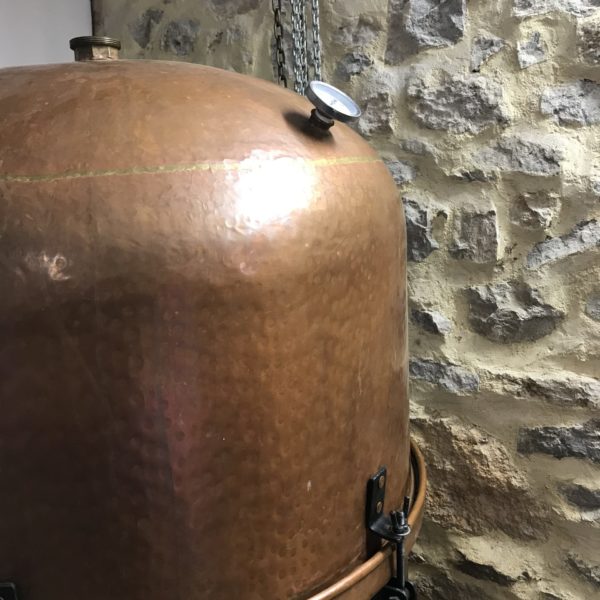
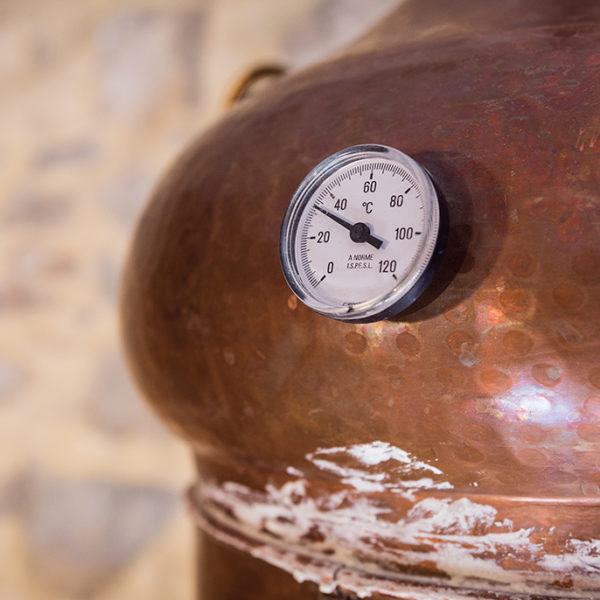
Copper, on the other hand, has been used for centuries and is still used today by distillers concerned with the subtlety of their production and the soul of their essential oils and hydrolats. Unlike stainless steel, copper is not neutral: an exchange takes place inside the alembic between the copper and the distilled plant. The essential oil produced in a copper alembic is a reflection of the material: colorful, warm, round and communicative.
Copper distillation, its advantages… and disadvantages
Copper is an essential trace element for the human body, promoting immunity and protecting against infection. As a result of the exchange between copper and the plant during distillation, essential oils and hydrosols become attached to copper molecules. Copper is one of the best metals for conducting heat, heating quickly and evenly and thus reducing heat loss in the still. It also cools very quickly, making it easy to handle at the end of the distillation process. Copper is antiseptic and bactericidal, and has the power to neutralize many germs and bacteria that are capable of living on stainless steel.
Unlike stainless steel, copper is softer and less shock-resistant, making it more fragile. It also requires more maintenance to prevent oxidation from contact with air and humidity. So clean regularly with white vinegar, rinse and dry quickly.
Copper, better preservation …
Any product that comes into contact with copper keeps better and longer. This is particularly true of hydrolats, which are reputed to be very fragile and unstable. Hydrolats distilled in our copper alembics are highly stable, and can be kept for over 2 years after distillation without the appearance of mucilaginous filaments or any loss of fragrance intensity. Copper also has the immense advantage of giving essential oils and hydrolats fragrances of exceptional intensity and roundness. Perfumers and liqueur makers are well aware of this, and work exclusively with copper stills.
At Boèmia, a producer of handcrafted essential oils, our alembics are designed by us and then made in copper in Portugal by master craftsmen whose expertise has been recognized for decades.
Distillation is an alchemical art. For Boèmia, the choices made upstream and the subtle exchanges between the plant, the materials and the man behind the still result in exceptional essential oils and hydrosols.