The label of an essential oil must include a certain number of compulsory indications. Since essential oils are natural products of widely varying quality, it can be difficult to make the right choice. How can you recognize a quality product? How can you understand what you’re buying? All the information you need is on the label, you just have to know how to decipher it.
1. The plant’s common name and botanical name in Latin
Why a Latin name? Because a plant generally has several popular names, e.g. (Farigoule, thyme), with the scientific botanical name, there’s no room for error. The Latin name tells you with certainty what type of plant it is.
2. Net quantity
The quantity by volume is mandatory information on the label.‘It can be given in ml or grams.
3. The distilled part
This information is very important, as the properties of the‘essential oil change according to the area distilled (flower, leaf, stem, bark, root, wood, etc.). A leaf will not contain the same biochemical components and in the same proportions as a flower.‘A leaf will not contain the same biochemical components in the same proportions as a flower, and so will not have the same therapeutic virtues.
For example, the bitter orange tree Citrus aurantium yields 3 different essential oils depending on the organ harvested. Distillation of the flowers yields neroli essential oil, distillation of the leaves yields petit grain bigarade essential oil, and pressing of the peel yields bitter orange oil.
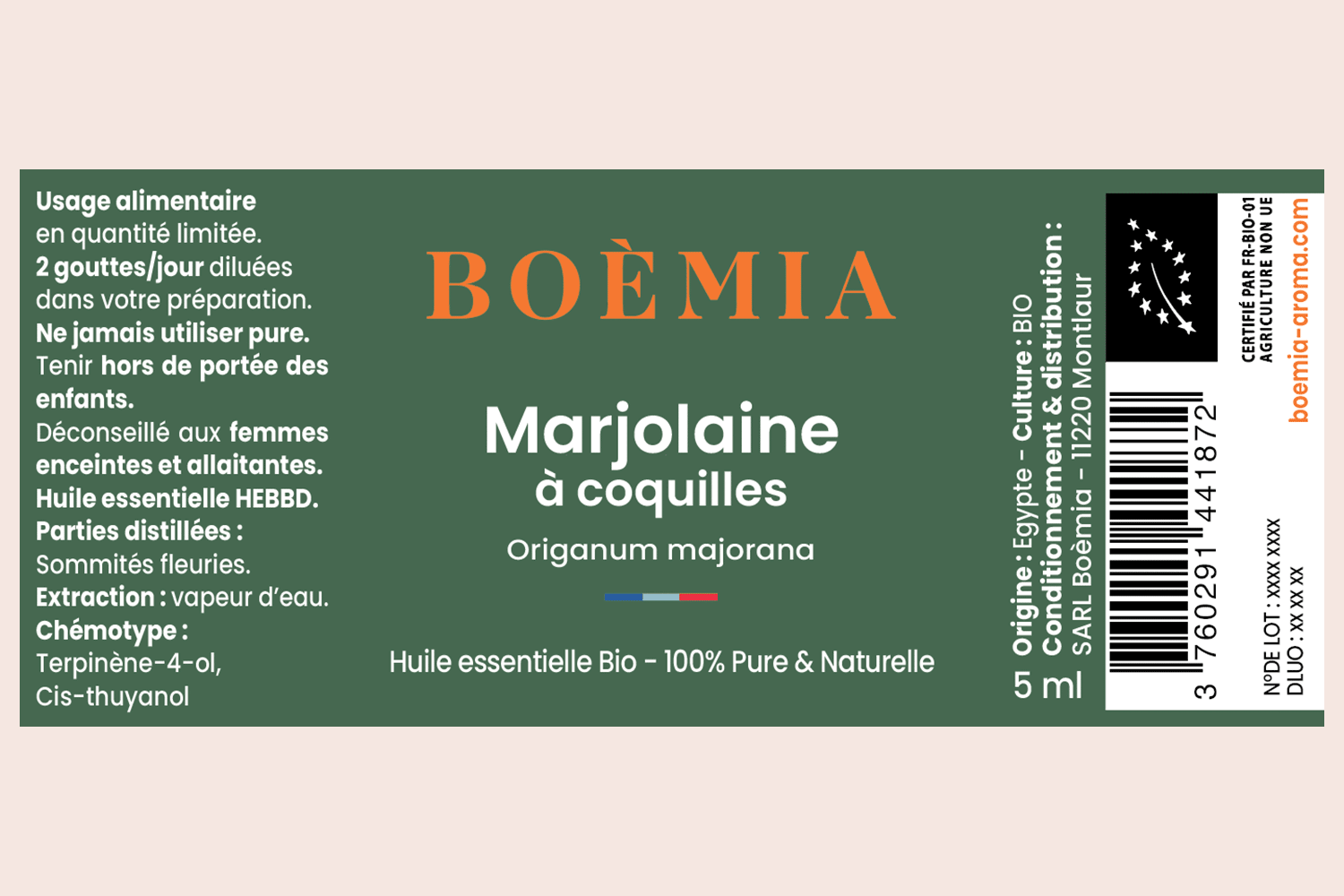
4. The extraction process
The‘obtaining an essential oil can vary. For example, you may find steam distillation or mechanical expression (generally used for citrus fruits). Pay close attention to this information, as some products are sold under the label “essential oil” when in fact they are not.‘they‘are not.
5. Geographical origin
This refers to the geographical area or country. This is a good indication of the plant’s quality. In fact, quality varies from‘one region‘to another, from one country to another. Fine lavender essential oil, for example, may be imported from Bulgaria or even further afield from China, or simply produced in France. It can also be wild-harvested. These differences do not‘will not have the same impact on quality, environmental and social value.
By buying local. To a lesser extent of course, when the plant allows it and has small artisanal producer brands. You help maintain‘local, sustainable farming that respects the environment.‘environment and the‘human.
You won’t be able to buy ravintsara essential oil produced in France, and even if this were possible thanks to technology, the quality and soul will be inferior. The finest Ravintsara essential oils come from tropical climates, and the finest thyme essential oils from more or less mountainous Mediterranean climates.
At Boèmia, we promote aromatherapy that is comprehensive, global and always of the highest therapeutic, social and environmental quality.
We invite you to work with essential oils from local plants when your needs are sufficient, but also for other needs with more exotic essential oils that have exceptional properties.
The powers of aromatherapy are exceptional and still underestimated, and it would be just as much of a shame to miss out on such gems of nature as essential oils of tea-tree, ravintsara and so on, as not to discover a Pyrenean thujanol thyme in more exotic latitudes where it cannot be grown. That’s why we work to ensure consistency in the geographical origin of each essential oil, its mode of transport, and its social and environmental ethics in the area of production.
6. Growing method
Whether conventionally grown, organically cultivated or wild-picked, plants do not produce the same qualities.
Why is that? Because the work is different. Whether over-mechanized or done exclusively by hand, in conventional agriculture, chemicals are added to the crop. Herbicides, fungicides and insecticides are all harmful products that end up in the essential oil.
You should therefore opt for certified organic essential oils and systematically avoid conventional essential oils.
Of course, the best quality comes from essential oils made from certified organic wild plants. But wild plants are not enough to meet the growing worldwide demand for essential oils. That’s why at Boèmia we also cultivate plants on our own plots to complement our wild plant gatherings. We try to produce plants in a “semi-wild” mode, with as little intervention as possible.
7. Essential oil chemotype (ch)
The chemotype (noted CH or CT) indicates the biochemically active majority molecule(s). It enables us to determine the precise characteristics and properties of each plant essence. In a way, it’s…
“The identity card, the DNA”, the chemical sub-category of essential oil within the same plant species. According to the chemotype, the essential oil’s composition and consequently its use are different. In short, it helps define the essential oil chemically.
Indispensable! the above example of True lavender. Some labels fail to specify the variety of lavender and its chemotype. The wrong labels may read “Lavender essential oil”.
Boèmia labels bear the HEBBD designation. What does this mean?
EOBBD (Essential Oil Botanically and Biochemically Defined) is an indication that our essential oils are fully defined both botanically and chemically, from identification at harvest, to distillation and extracted molecules.
8. Shelf life and batch number
Boèmia labels read DDM (date of minimum durability)
This information must appear on the label, but the date can be exceeded when essential oils are properly stored.
The DDM is different from the DLC (Best Before Date).
High-quality essential oils, where every step has been meticulously carried out from harvesting to distillation and bottling, can be kept for many years in the dark, and often exceed the DDM noted on the bottle.
The batch number is also an important concept to find on a‘essential oil label, as it enables product traceability. It also enables us to draw up technical data sheets tracing the essential oil’s history.