What if you stopped pouring essential oils into your washing powder?
Lavender, sweet orange, geranium, tea tree… These flowers and citrus fruits produce powerful, yet highly volatile oils. The result: you pour 10 drops into your bottle of homemade detergent, add a spoonful to the fabric softener compartment, hope for delicately scented laundry… and you get nothing. Or almost nothing.
Can essential oils for laundry be washed in the washing machine?
Betweenhot water, Marseille soap, soda crystals, rinse cycles and absorbent cloths, theessential oil is destroyed or eliminated before it can take effect. Worse: you’re wasting a precious, eco-sensitive, expensive ingredient, for no olfactory pleasure… and a very real environmental impact.
In this article, you’ll discover why this practice isn’t appropriate and, above all, what gentle, effective and environmentally-friendly alternatives you can adopt to perfume your laundry without compromising the skin, the planet or the quality of textile care.
Why adding essential oils to natural laundry detergent is neither effective nor environmentally friendly
Very limited effectiveness on linen
Adding 10 to 30 drops of essential oil to your washing machine is no guarantee of long-lasting fragrance. Quite the contrary, in fact.Essential oils, by definition, are volatile: they are easily eliminated, notably by the effect ofhot water, the heat of the cycle, the presence of soap, or simply the final rinse.
The result: even if you pour several drops into the fabric softener compartment, there’s often no perceptible scent left on the dry linen. And if a fresh scent is perceptible on leaving the machine, it generally disappears when drying or ironing.
Even more problematic: in order to “smell something”, some people come to overdose the oils, thinking that the linen will be better scented as a result. This does not improve theeffectiveness of essential oils, but increases the risks (irritation, stains, waste).
💬 Simple conclusion: perfuming your machine laundry with essential oils is not the right method. There are more effective alternatives, which we’ll look at below.
A contradictory environmental impact
Essential oil + detergent = danger?
We think we’re doing the right thing, we think we’re acting “naturally”… and yet adding a few drops ofessential oils to our laundry often makes ecological sense.
Why should we? Because a 10 ml bottle of recommended essential oils (lavender, lemon, rose geranium…) represents between 1 and 3 kg of fresh plant matter. For some citrus flowers or zests, it’s even more. The distillation process requires time, energy and resources, which justifies its price and power.
However, once poured into the detergent, these concentrated substances are poorly soluble in water. They do not adhere to the fabric, but are usually discharged with the wastewater, having served no purpose. The result: no beneficial effects, but residual pollution of aquatic environments (notably due to their impact on useful bacterial flora). A household product that doesn’t respect the environment is the opposite of what was intended.
Products too precious to waste
Visit essential oils are powerful, complex and expensive to produce. Their effectiveness depends on targeted use, in low doses, in conditions where their therapeutic or olfactory properties can really be exploited.
Putting them in a washing machine cycle, at 40 or 60°C, is like putting organic wine in a pressure cooker: the essence is lost, and there are no serious tests demonstrating real effectiveness in this context.
And yet, we continue to see vague recommendations: “pour 5 drops into the fabric softener compartment”, “add to your laundry to perfume naturally”… But no reliable study, no informed recommendation, supports this practice. On the contrary, aromatherapy experts recommend reserving essential oils for precise, measured uses that respect their potency.
💬 In short: it’s neither a good precaution nor a good use. It’s a common reflex, but one that we need to learn to question if we’re looking for a truly ecological solution.
Scenting your laundry naturally: really effective alternatives
Just because a natural essential oil can’t withstand heat or the rinse cycle, that doesn’t mean you have to give up all natural fragrance or fresh scent on your laundry. There are more effective, gentler and much more ecological solutions for scenting laundry without risk… or waste.
Spray post-wash laundry water
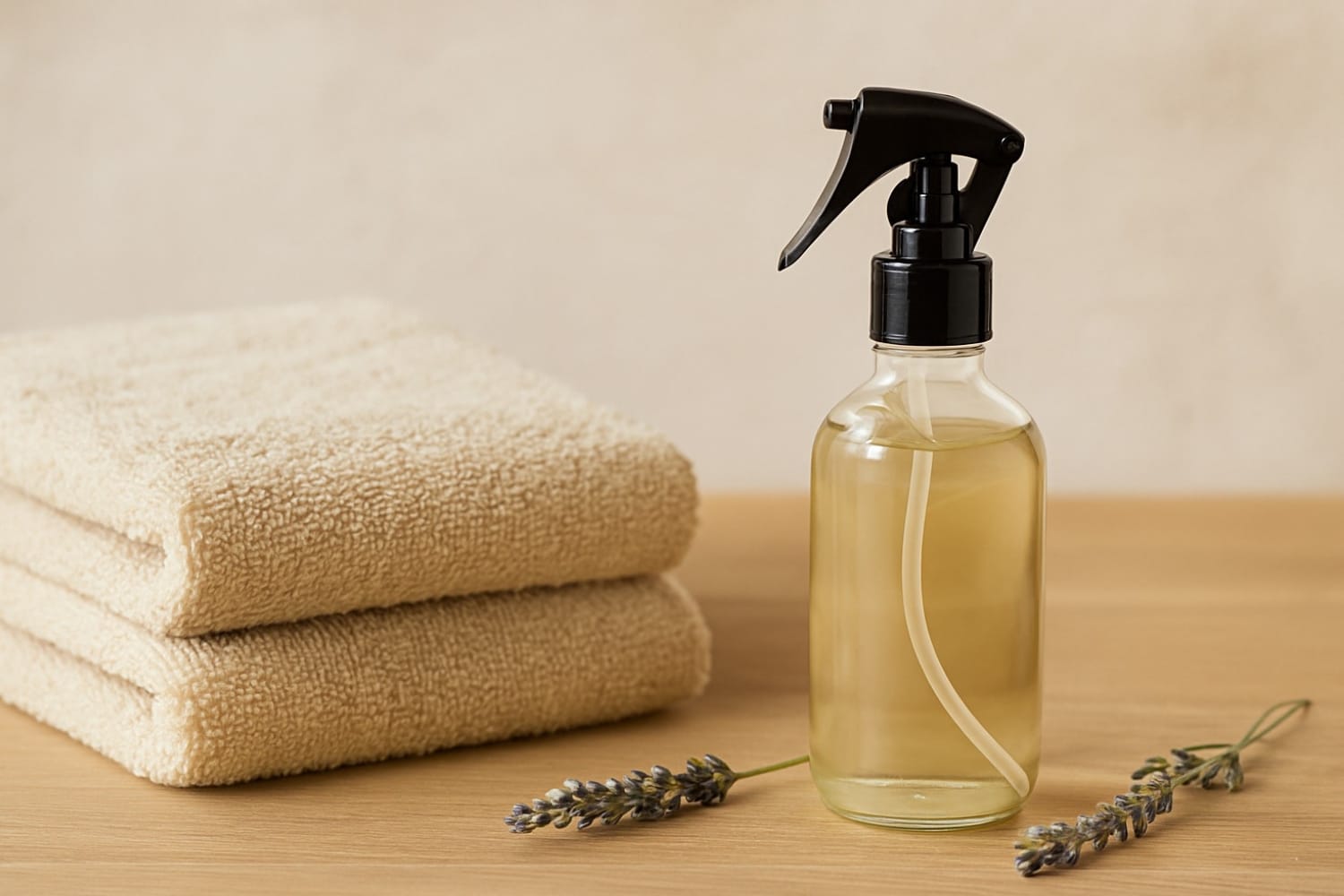
The simplest and most effective solution is to prepare a scented laundry water, to be sprayed onto dry linen once it has come out of the machine. This method allows the aroma to set in without being altered by the heat or humidity of the wash cycle.
🧪 Ingredients:
100 ml demineralized or spring water
4 tablespoons alcohol (vodka or undenatured 70° alcohol)
3 to 5 drops maximum of essential oil (true lavendersweet orange, petitgrain bigarade…)
- A spray to diffuse
💬 By choosing your blend carefully, you get a fresh, long-lasting, personalized scent, to use after ironing or simply as a light spray in the wardrobe.
🎯 So you can add a safe, effective olfactory ritual to your laundry that’s much more respectful of the properties of essential oils.
Scenting your laundry with hydrolats: a gentle, responsible alternative
The hydrolats (or floral waters) are very mild, aromatic products derived from the distillation of plants. Unlike essential oils, they are water-soluble, low in concentration and suitable for light textile use… provided you use them at the right time.
💧 Rather than pouring them into the washing machine, where they would be largely eliminated during rinsing, we recommend a light spray on clean, dry linen, after washing. This simple gesture respects the integrity of the product and allows you to really enjoy it.
The most pleasant hydrosols for laundry:
Orange Blossom Sweet, soothing scent
Lavender officinalis purifying and relaxing effect
Damask Rose an elegant, flowery fragrance
Rose Geranium fresh, slightly sweet note
📝 This post-wash gesture advantageously replaces perfumed fabric softeners or conventional textile sprays. It’s a natural, economical alternative that’s 100% environmentally friendly.
📌 Directions for use: transfer the hydrosol to a glass spray bottle, and spray gently onto dry linen or when ironing, from a distance of 20-30 cm. Keep the bottle away from light and heat, for 1 to 3 months after opening.
Delicate linen, baby, sensitive skin: zero essential oils
When washing the laundry of an infant, a person with allergies, or simply someone with fragile skin, absolute caution is called for.
Even diluted essential oils may contain potentially irritating or sensitizing molecules. In the absence of a formal therapeutic need, it is preferable to refrain from using them altogether.
✔️ What you can use :
Chamomile or lavender hydrolate (cosmetic grade)
White vinegar alone for softening and antibacterial properties
Homemade detergent with no added fragrance
❌ What to avoid:
Any direct application of essential oils to linen
Oils with phenols, ketones or oxides (clove, eucalyptus, peppermint essential oil, oregano…)
Blind” tests on textiles without prior dilution
💬 Frequently asked questions - essential oils and detergents
Are essential oils effective for scenting laundry?
The Internet is full of opinions on the subject. In reality, adding essential oils to laundry detergent (whether homemade or industrial) is not the best way to perfume your clothes. Under the effect of heat, water, soda crystals or Marseille soap, the fresh scent of true lavender or sweet orange quickly fades. The effectiveness of essential oils is therefore reduced by various factors. The result: no lasting fragrance, despite the addition of several drops.
How many drops are needed to effectively perfume a washing machine?
We often see recommendations such as “add 10 to 30 drops to the fabric softener compartment”. However, no serious test has shown that even this high dose produces an even, persistent fragrance on the fabric. The essential oil is too volatile to withstand a wash cycle.
Which essential oils for laundry?
If you insist on using one, choose lavandin super or grosso (lavandula hybrida). But beware: in a liquid preparation, dispersion remains uneven without an emulsifying agent. The ideal solution is a post-wash textile spray based on demineralized water, alcohol and a few drops of oil. To sum up, chooselavender or lavandinessential oil, rose geranium essential oil, lemon essential oil, tea tree essential oil. In all cases, give priority to organic essential oils, such as citrus essential oils or rose geranium essential oils.
How to use essential oils in laundry detergent?
Mixing essential oils into laundry detergent raises a lot of questions. We often hear that all you need to do is pour 5 drops into the fabric softener compartment, or add a few drops of the essential oil of your choice, such as lavender or lemon, to your liquid detergent.
In reality, this mode of use is neither optimal, nor environmentally friendly, nor recommended:
- Essential oils are sparingly soluble in water.
- Under the effect of machine heat, washing and rinsing, they are either eliminated or degraded.
- The fragrance doesn’t last, and the quantity needed to achieve an effect (10-30 drops per cycle) is disproportionate, costly and environmentally unfriendly.
💡 Tips & precautions :
For more effective use, prefer a post-wash textile spray. These are gentler, longer-lasting alternatives that are suitable for all types of laundry, provided you follow the recommended dosage.
Why not put the essential oils directly into the drum?
Pouring a bottle or spoonful of EO directly onto clothing is a bad idea. In contact with heat and humidity, they can irritate the skin, stain fabrics or alter natural fibers. This type of use is not suitable for fragile clothes, nor for washing at high temperatures.
Can essential oils be used in baby detergent?
No. Even when diluted, essential oils are still powerful substances, sometimes allergenic. For babies’ laundry, sensitive skin or skin conditions, it’s best to avoid all essential oils, perfumes and additives. Use a simple homemade detergent based on soap flakes or shavings, hot water, white vinegar and baking soda. It’s a gentler option for the whole family, healthy and environmentally friendly.
What's the most effective, natural alternative for scenting your laundry?
The best solution is to apply a homemade fabric spray after washing. Mix in a glass bottle:
100 ml demineralized water,
1 tablespoon alcohol,
3 to 5 drops of an organic essential oil (lavandin, orange, grapefruit, lavender).
This type of preparation is easy to make, economical, and allows you to delicately scent your linen when ironing or putting it away, without risk to the skin.
How to store homemade detergents or EO-based preparations?
Essential oils are sensitive to light, heat and oxygen. To preserve a homemade recipe based onecological ingredients (soap, soda, hydrolat, etc.), store it in a tinted glass bottle,away from light and in a cool place. Shake before each use. Depending on the formula, the product will keep for 1 to 2 months maximum.
Why choose Boèmia for responsible linen scenting?
At Boèmia, we believe that clean laundry should not compromise the health of your skin or that of the planet. We also believe that it’s possible to combine olfactory pleasure, efficiency and commitment, without giving in to bad practices like addingessential oils to the washing machine.
Pure, organic essential oils designed for rational use
Our essential oils of true lavenderorganic lemon and rose geranium essential oils are carefully distilled with respect for the plants, soils and people who grow them. They are not designed to be diluted in liters of soapy water at 60°C, but to be used where they will be truly effective and appreciated: in a home textile spray, for diffusion, or in sustainable cosmetics.
By choosing Boèmia, you’re opting for an essential oil of impeccable quality, total traceability and fair use of resources.
Our hydrolats: the safe alternative for sensitive skin
Less concentrated than oils, hydrolats are an ideal alternative for scenting laundry while respecting delicate skin. They are suitable for babies, reactive skin and those who prefer a gentler approach.
🫧 Orange blossom, true lavender, Damask rose: our hydrolats are certified organic, ready-to-use and perfect for use on clean linen, to be sprayed before putting away or after ironing.
🔗 Discover our organic hydrolats
Boèmia: a sustainable, coherent approach that respects living organisms
No greenwashing. No waste. No exaggerated promises.
Just natural products, made with consistency, that meet real needs: perfume with pleasure, protect what counts, and be part of a global approach to care and common sense.
Because clean laundry is good.
Healthy, naturally scented linen that respects the environment?
This is our mission.

Editor: Camille Comet
Doctor of Pharmacy University Diploma (DU) in Aromatherapy
Fascinated by the power of plants since childhood, my expertise and passion focus on aromatherapy and the production of essential oils, with an ethical and ecological vision.
FAQ - Essential oils & detergents
Which essential oils to use in your homemade laundry?
For homemade laundry, the essential oils most frequently mentioned arelavender essential oil,lemon essential oil andtea tree essential oil. In practice, their olfactory hold on laundry is weak after rinsing. For a consistent result, save them for a post-wash textile spray or, if you insist, to perfume your linen when ironing. For delicate linen and essential oils for babies, it’s best to avoid them and use a gentle hydrosol instead.
How to scent your washing powder naturally?
To perfume your laundry without overdosing, forget the machine tank: heat and rinsing dissipate a natural fragrance. Instead, opt for a post-wash mist: demineralized water + alcohol (a little vodka, for example) + a small amount of aroma, to be sprayed onto dry fabric after shaking for a pleasant scent. This is more effective than “adding a few drops” to the tub, and gives your laundry a long-lasting scent. Be careful to choose colorless essential oils to avoid staining. With this in mind, avoid mandarin!
Which ingredients for homemade detergent?
The tried-and-tested base remains grated Marseille soap or soap shavings, baking soda to boost washing, and optional white vinegar in the softening tank. This simple laundry recipe, based onnatural ingredients, respects the fiber and limits the environmental footprint. Prepare small volumes and shake before use.
What are the benefits of essential oils?
Oils are said to have a purifying effect, mild antibacterial properties and a fresh scent. On textiles, these benefits of essential oils are best expressed out of the machine, via a wardrobe mist: the lasting scent holds because it is no longer destroyed by hot water and rinsing. This is the most rational way to enjoy a pleasant fragrance.
How to use essential oils in laundry
The reflex to “use essential oils” in the tank often disappoints: they are poorly soluble and disperse poorly. If you persist, avoid mixing essential oils in the drum. Instead, add a suitable dispersant to the liquid detergent, or better still, use a post-wash spray. In all cases, essential oils should be used sparingly, tested beforehand and the label text respected.
How much essential oil for laundry detergent?
The tutorials quote a recommended number of drops of 10 to 15 drops per machine. That’s a lot of essential oil wasted. In essential oil dosage, stick to a small quantity in textile mist (3 to 5 drops per 100 ml). Avoid large quantities in fabric softeners: they won’t hold and may mark certain fibers.
What precautions should I take with essential oils?
Remember to take precautions when using: risk ofallergy on reactive skin, stained textures in direct contact, and environmental impact if you pour repeated volumes into the machine. People